Unraveling the D'Lisa Kelley Case: A Timeline of Tragedy and Questionable Investigation

Welcome back to the blog, where we dive deeper into the stories that haunt us. In the latest episode, I explored the heartbreaking and infuriating case of D'Lisa Kelley, a young mother whose life was tragically cut short in 2014. This post will expand on those details, meticulously examining the timeline of events and the critical moments where the investigation into her murder appears to have faltered. We'll also touch upon the troubling parallels with another case that has cast a long shadow over the Dallas Police Department, setting the stage for a deeper understanding of the systemic issues at play. If you haven't listened to Chapter 130: A Failure of Justice-The Murder of D’Lisa Kelley, I highly recommend doing so before diving into this post. It provides the emotional context and narrative that underpins the cold, hard facts we'll be dissecting here.
Setting the Scene: Who Was D'Lisa Kelley?

D'Lisa Kelley
Before diving into the grim details of her murder and the subsequent investigation, it's crucial to remember D'Lisa Kelley as a person. She was a vibrant young woman, a devoted mother, and, at the time of her death, was pregnant with her second child. She was described by friends and family as energetic, loving, and someone who radiated joy. Her life was full of promise, a promise that was brutally extinguished far too soon. The loss of D'Lisa was not just the loss of an individual; it was the shattering of a family and the theft of a future. Her story is a stark reminder that behind every cold case statistic is a life that mattered, a life that deserved justice.
The Timeline of Events: From Disappearance to Discovery
The events leading up to D'Lisa Kelley's death paint a picture of growing unease and a desperate search that tragically ended in discovery. Understanding this timeline is paramount to grasping the failures in the investigation.
March 7, 2014 4:30pm: D'Lisa Kelley, then 24 years old, was last seen at her grandmother's home in Dallas, Texas. She was on her way to a funeral for her best friend who lost her life in a car accident.
6:13pm: D'Lisa is observed on surveillance footage exiting a Stop & Save on the corner of Sunnyvale and Overton Road before getting into a blue 1986 Mercury Grand Marquis.
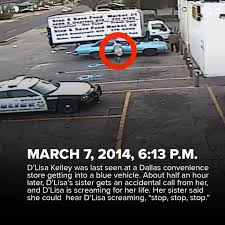
6:45pm: D'Lisa's sister, Jasmine, receives a call from her. Believed to be a pocket dial, D'Lisa can be heard yelling, "Stop! Stop! Get off me!" and an unknown male can be heard saying, "Shut up! Stop screaming! You want to be hardheaded." The call lasts approximately 1 minute and 11 seconds before being disconnected.
7:00pm: After 15 minutes of trying to get in contact with her, Jasmine receives a text from D'Lisa saying she'd call her in a minute. She never does. Jasmine texts again, asking if she was being hurt, and D'Lisa responds saying, "He thought I was with someone else." This is the last contact made to D'Lisa.
8:30pm: After multiple failed attempts to reach D'Lisa, Jasmine calls their grandmother, Marjurita, and explains what she heard. Marjurita calls the Dallas Police, and the dispatcher contacts Sergeant Kevin Mansell to ask if a missing person's report should be made. The dispatcher explains that D'Lisa has never gone missing before, and she was two months pregnant. Sgt. Mansell responds with, "Well sounds like she's been missing before. That's how she got in that situation." Sgt. Mansell only attempts to have D'Lisa's location triangulated by her cell phone provider. When they fail to find her location, he requests they keep trying. The call from Marjurita is forgotten about.
March 8, 2014: After another call to police when D'Lisa fails to return home, an officer responds and makes a Want to Locate Report.
March 9, 2014: D'Lisa's case is finally assigned to an investigator in the Youth Operations and Missing Persons Department. Her family and boyfriend are interviewed and an Endangered Person Bulletin is sent out. Police receive her call log, but her last known recorded location is before she was reported as being in danger.
March 10, 2014: Police arrive at Marjurita's home to canvas the area, but nothing is found. Police confer with DART (the Dallas Area Rapid Transit Police) to see if D'Lisa borded a bus, and morgues, hospitals, and othe police departments are contacted to verify if anyone matching her description had shown up.
March 11, 2014: A witness comes forward saying that they had seen D'Lisa enter their business. Surveillance was unable to be recovered to verify.
March 13, 2014: Police are notified that D'Lisa had been seen at Stop & Save on the 7th.
March 14, 2014: Investigators are notified by a South Central Police Officer that a body had been found on the porch of an abandoned home locatd at 1215 Presidio Avenue in Oak Cliff.
The Autopsy confirms that the body is that of D'Lisa Kelley. She had been beaten and strangled, with her hand and jaw crushed. It was determined she had died three days after she had been reported missing.
This timeline, though seemingly straightforward, is burdened by unanswered questions and a sense of what could have been. Each day that passed without D'Lisa being found, and each detail uncovered, added layers of pain and frustration for her loved ones.
The Initial Investigation: Red Flags and Missed Opportunities
From the outset, the investigation into D'Lisa Kelley's murder was plagued by what many, including her family, perceive as significant missteps and a lack of urgency. These initial red flags are crucial to understanding why the case remains unsolved a decade later.
One of the most critical points of contention is the initial response to the 911 calls concerning D'Lisa. According to reports and audio recordings that have since emerged, there was a significant delay and apparent confusion in dispatching officers to D'Lisa's residence after her grandmother called to report her missing and express fears for her safety. The grandmother’s call itself seems to indicate an awareness of potential danger, yet the response did not appear to reflect the urgency of the situation. This hesitation and perceived lack of priority in the early hours are often cited as a major missed opportunity.
The family's repeated attempts to provide information and express their concerns also seem to have been met with a degree of indifference or inefficiency. D'Lisa's family has tirelessly advocated for her and they've been vocal in their accounts of a struggle to get law enforcement to act with the necessary speed and dedication. The perception that the police department was not treating the case with the utmost seriousness from the beginning has been a persistent source of pain and anger for D'Lisa's family.
These early shortcomings created a foundation of distrust and frustration, making the path to justice an uphill battle. The initial moments of an investigation are often the most critical, and it appears that in D'Lisa's case, crucial time and opportunities may have slipped through the cracks.
Key Moments in the Investigation: Examining the Evidence
As the investigation progressed, several key moments and pieces of evidence came to light, or failed to materialize, further complicating the search for answers in D'Lisa Kelley's murder. The availability of audio recordings from the 911 calls and dispatchers has been particularly illuminating, albeit in a deeply unsettling way.
The audio from the initial 911 call placed by D'Lisa's grandmother is pivotal. It conveys a palpable sense of fear and desperation as the grandmother describes her granddaughter's disappearance and her concerns about the father of D'Lisa's unborn child. What is particularly troubling is the subsequent audio from the call to Sgt. Mansell. The conversation appears to involve the sergeant downplaying the situation or delaying the dispatch of officers, with phrases that suggest a lack of immediate action or a belief that the situation wasn't as dire as reported. This alleged exchange has been at the heart of accusations that the police department did not adequately respond to early warning signs.
Another critical aspect of the investigation revolves around the driver of the Grand Marquis. While he was found and interviewed, there was a lack of evidence publicized to tie him to her disappearance, and police have never revealed his name or named him as a suspect.
The passage of time itself becomes a factor. As weeks turn into months, and months into years, evidence can degrade, witnesses may move or forget details, and the initial urgency can dissipate. The effective collection and preservation of evidence in the critical early stages are therefore of utmost importance, and it is in these areas that many questions linger regarding D'Lisa Kelley's case.
The Dallas Police Sergeant Connection: A Troubling Overlap
Perhaps one of the most disturbing aspects of the D'Lisa Kelley case is the emergence of a connection to a Dallas Police sergeant who was later involved in another high-profile, controversial case: the death of Tony Timpa. This overlap raises profound questions about accountability, oversight, and the potential for systemic issues within the Dallas Police Department.

Tony Timpa
The Tony Timpa case, which occurred in 2016, involved a mentally distressed man who called 911 for help. Tragically, Timpa died after being restrained by Dallas police officers, including the sergeant who had prior contact with the Kelley investigation. The Timpa case became a flashpoint for discussions about police use of force, de-escalation tactics, and the accountability of officers involved in in-custody deaths. The fact that a sergeant involved in the early stages of the Kelley investigation was also a central figure in the Timpa controversy has led many to question whether the failures in one case were indicative of a pattern or a cultural issue within the department.
This connection is not merely a coincidence; it serves as a stark reminder that the concerns raised by D'Lisa Kelley's family are not isolated incidents. The involvement of the same officer in two highly scrutinized cases, one an unsolved murder and the other a death during an arrest, amplifies the calls for transparency and reform within the Dallas Police Department. It compels us to ask: were there red flags in the Kelley investigation that were overlooked due to departmental practices, and did those same practices contribute to the tragic outcome in the Timpa case?
The Tony Timpa Case: Parallels in Controversy
To fully understand the weight of the Dallas Police Sergeant connection in D'Lisa Kelley's case, it's essential to briefly outline the controversy surrounding Tony Timpa. While the specifics of each case are distinct, the underlying themes of questionable police conduct and the struggle for justice resonate disturbingly.
Tony Timpa, a father struggling with mental health issues, called 911 in August 2016 seeking help. Instead of receiving the support he desperately needed, he was met by Dallas police officers. During the interaction, Timpa was subdued, restrained, and ultimately died. Multiple officers were involved, including the sergeant who had prior connections to the D'Lisa Kelley investigation. Recordings of the incident captured Timpa repeatedly pleading for help and officers using force.
The aftermath of Timpa's death was marked by protracted legal battles. His family pursued a wrongful death lawsuit, arguing that the officers' actions were excessive and led to his demise. The trial itself highlighted the complexities of accountability in police misconduct cases, particularly in the face of qualified immunity, a legal defense that protects government officials from liability in civil lawsuits unless their conduct violates clearly established statutory or constitutional rights.
The jury's eventual verdict in the Timpa case, while finding some officers liable, also granted qualified immunity to others, leading to a sense of incomplete justice for Timpa's family. This outcome, coupled with the sergeant's prior involvement in the Kelley investigation, fueled public outcry and reinforced the perception that the system designed to protect citizens might, in some instances, fail them.
The parallels are clear: in both cases, there are allegations of inadequate response, excessive force or mishandled situations, and a prolonged fight for accountability. The involvement of the same officer in both scenarios forces a critical examination of how such issues are addressed within the Dallas Police Department and whether sufficient safeguards are in place to prevent similar tragedies and ensure justice for victims and their families.
Questions of Accountability and Oversight
The D'Lisa Kelley case and the Tony Timpa case, particularly with the involvement of the same Dallas Police sergeant, inevitably leads to profound questions about accountability and oversight within the Dallas Police Department. These are not abstract legal or procedural issues; they are deeply personal concerns for the families of those affected and for the broader community seeking to trust their law enforcement agencies.
One of the primary questions centers on the internal investigative processes of the Dallas Police Department. When serious allegations of misconduct or investigative failures arise, what mechanisms are in place to ensure a thorough, impartial, and timely review? In the Kelley case, the emergence of the 911 call audio raised immediate concerns about dispatch and officer response. Was there a comprehensive internal review of these initial actions? If so, what were the findings, and what measures were taken to address any identified shortcomings?
The issue of accountability is further complicated by the legal protections afforded to law enforcement officers, such as qualified immunity. While intended to allow officers to perform their duties without fear of constant litigation, critics argue that it can create a shield for misconduct, making it exceedingly difficult for victims and their families to obtain justice. The outcomes of legal challenges in both the Kelley and Timpa cases, directly or indirectly, reflect these complex legal landscapes.
Ultimately, the questions of accountability and oversight boil down to a fundamental societal expectation: that those entrusted with the power to enforce the law are themselves held to the highest standards of conduct and that there are robust systems in place to address failures when they occur. The lingering pain of D'Lisa Kelley's unsolved murder and the controversies surrounding the Timpa case suggest that there is significant room for improvement in achieving these critical objectives.
The Lingering Impact on D'Lisa Kelley's Family
For the family of D'Lisa Kelley, the unsolved nature of her murder represents a wound that has never truly healed. A decade has passed, yet they are still living with the pain of loss, the agony of unanswered questions, and the frustration of what they perceive as a failed justice system. The impact of this prolonged suffering cannot be overstated.
The lack of closure means that D'Lisa's son grows up without the full story of his mother's life and the perpetrator of her murder. This absence creates a void that can have profound long-term effects on their understanding of family, safety, and justice. The family is not only mourning a loss but is also actively engaged in a battle to ensure that D'Lisa's life and death are not in vain.
The family has also faced challenges in their interactions with the legal and law enforcement systems. Their efforts to obtain information, understand the investigation's progress, and hold those responsible accountable have often been met with bureaucratic hurdles and a perceived lack of empathy or urgency. This has undoubtedly exacerbated their pain and mistrust.
The lingering impact on D'Lisa Kelley's family is a stark reminder that unsolved crimes have ripple effects that extend far beyond the immediate tragedy. It is a continuous struggle for truth, justice, and the peace that can only come from knowing that those responsible have been held accountable.
The Kelley Alert: A Legacy of Advocacy
In the face of profound grief and a persistent lack of justice, D'Lisa Kelley's family, particularly her mother, Lasondra, channeled their pain into a powerful force for change. This advocacy led to the creation of the "Kelley Alert," a testament to their unwavering commitment and a lasting legacy in D'Lisa's name.
The Kelley Alert is modeled after the Amber Alert system, but it is specifically designed to alert the public and law enforcement to critically endangered missing persons who may have been abducted or are otherwise in imminent danger between the ages of 18 and 64. The goal is to mobilize resources and generate public awareness rapidly when someone disappears under suspicious circumstances. This initiative recognizes that time is of the essence in such cases and that widespread notification can be a critical factor in a successful rescue or recovery.
The journey to establishing the Kelley Alert was a significant legislative battle, reflecting the family's determination to ensure that other families would not have to endure the same agonizing uncertainty and perceived lack of timely response that they experienced. After years of advocacy, the Kelley Alert was signed into law in Texas. This legislative victory, while a positive development, is also a somber reminder of the circumstances that necessitated its creation.
The Kelley Alert is more than just a law; it is a symbol of resilience and a powerful tool that emerged from tragedy. It represents D'Lisa Kelley's enduring impact – her life, tragically cut short, has inspired a system designed to protect others. It is a living tribute to her memory and a beacon of hope for families facing similar nightmares.
This advocacy also underscores the importance of family involvement and persistence in cases where justice seems elusive. The Kelley family's dedication has not only pushed for systemic change but has also kept D'Lisa's story alive, reminding everyone that her case is not forgotten and that the fight for justice continues.
Conclusion: The Fight for Justice Continues
The story of D'Lisa Kelley is a tragic and complex one, filled with unanswered questions and a deep sense of injustice. In this blog post, we've meticulously traced the timeline of events, highlighting the critical junctures where the investigation appears to have faltered. We've examined the troubling red flags that emerged early on, the specific moments that have drawn scrutiny, and the disturbing connection to the Tony Timpa case, which raises serious concerns about accountability and oversight within the Dallas Police Department. The profound and lasting impact on D'Lisa's family, and the inspiring creation of the Kelley Alert as a legacy of their advocacy, serve as powerful reminders of the human cost of unsolved crimes.
This detailed exploration of the D'Lisa Kelley case is directly inspired by our latest podcast episode, Chapter 130: A Failure of Justice-The Murder of D’Lisa Kelley. The episode delves into the emotional narrative and the documented facts, providing a comprehensive account of this devastating case. As we've seen in this post, the fight for justice for D'Lisa Kelley is far from over. Her family continues to seek answers and accountability, and the community deserves to have faith in the systems designed to protect them. We urge anyone with information regarding D'Lisa's murder to come forward. The North Texas Crime Commission can be reached at 877-373-8477, or you can submit a tip through their website at www.ntcc.crimestoppersweb.com. Let's continue to shed light on these cases and advocate for the justice that D'Lisa and her family deserve. Thank you for reading, and thank you for listening.

The Power of a Name: Identifying the Kern and Ventura County Jane Does